


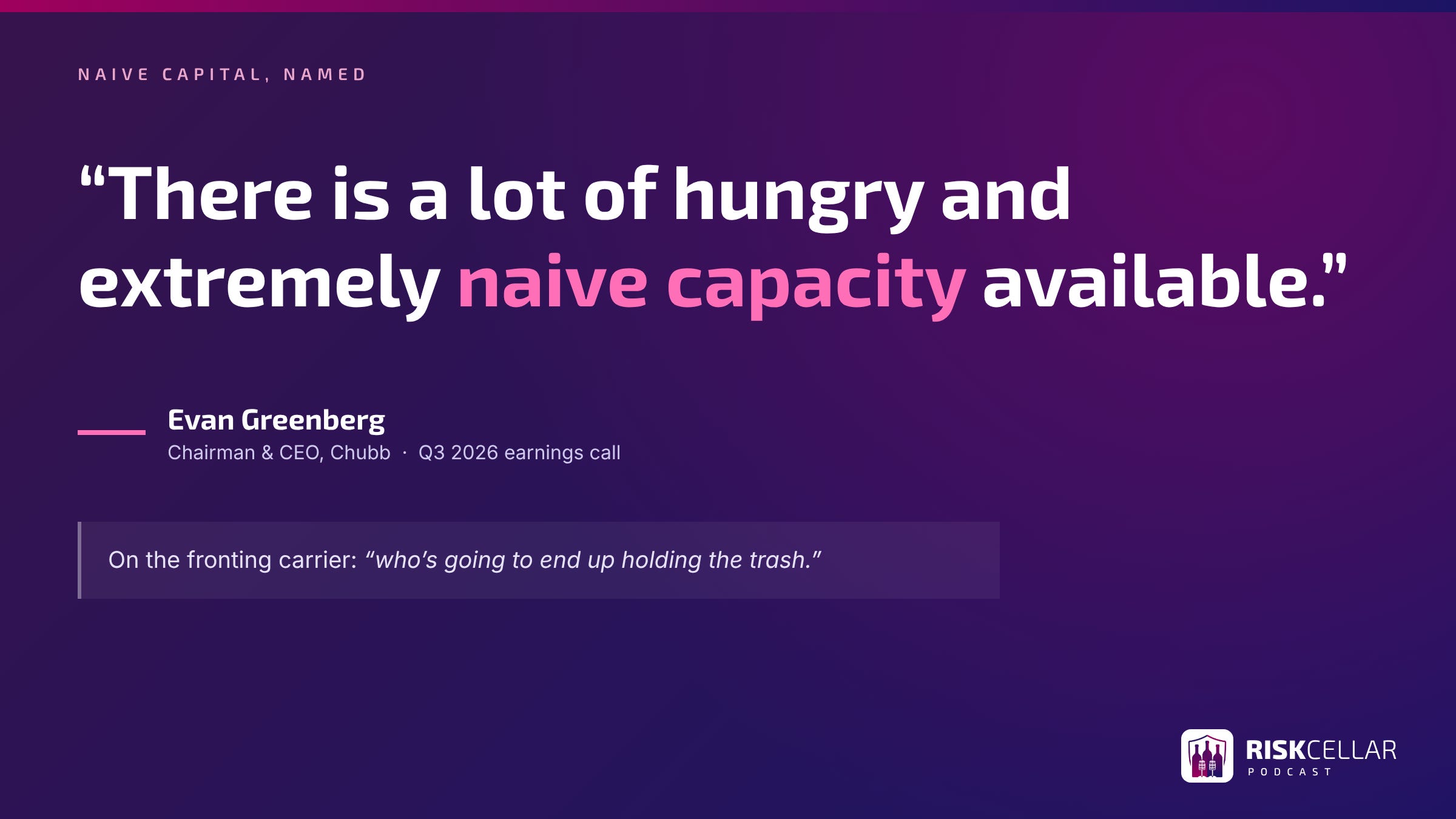
I just got back from WSIA, and two things were reaffirmed for me. First, brokers know how to have a damn good time. Second, the market is stuffed to the gills with naive capital. Evan Greenberg put a name to it on Chubb’s earnings call this week, calling it “hungry and extremely naive capacity.” But it didn’t take the CEO of Chubb to see what’s happening. Everyone knows it, and there are plenty of case studies to prove it. Let’s talk about one today.
How we got here
We’re in a softening market, but it’s an artificially soft one, led mostly by property declines over the past two years. And let’s be clear: neither property nor casualty is softening because claims are going down. Property softened because attachment points moved. Customers took on bigger wind and hail deductibles first, and then reinsurance attachments on treaty business went up. Casualty is softening partly because it sits next to property in the marketplace.
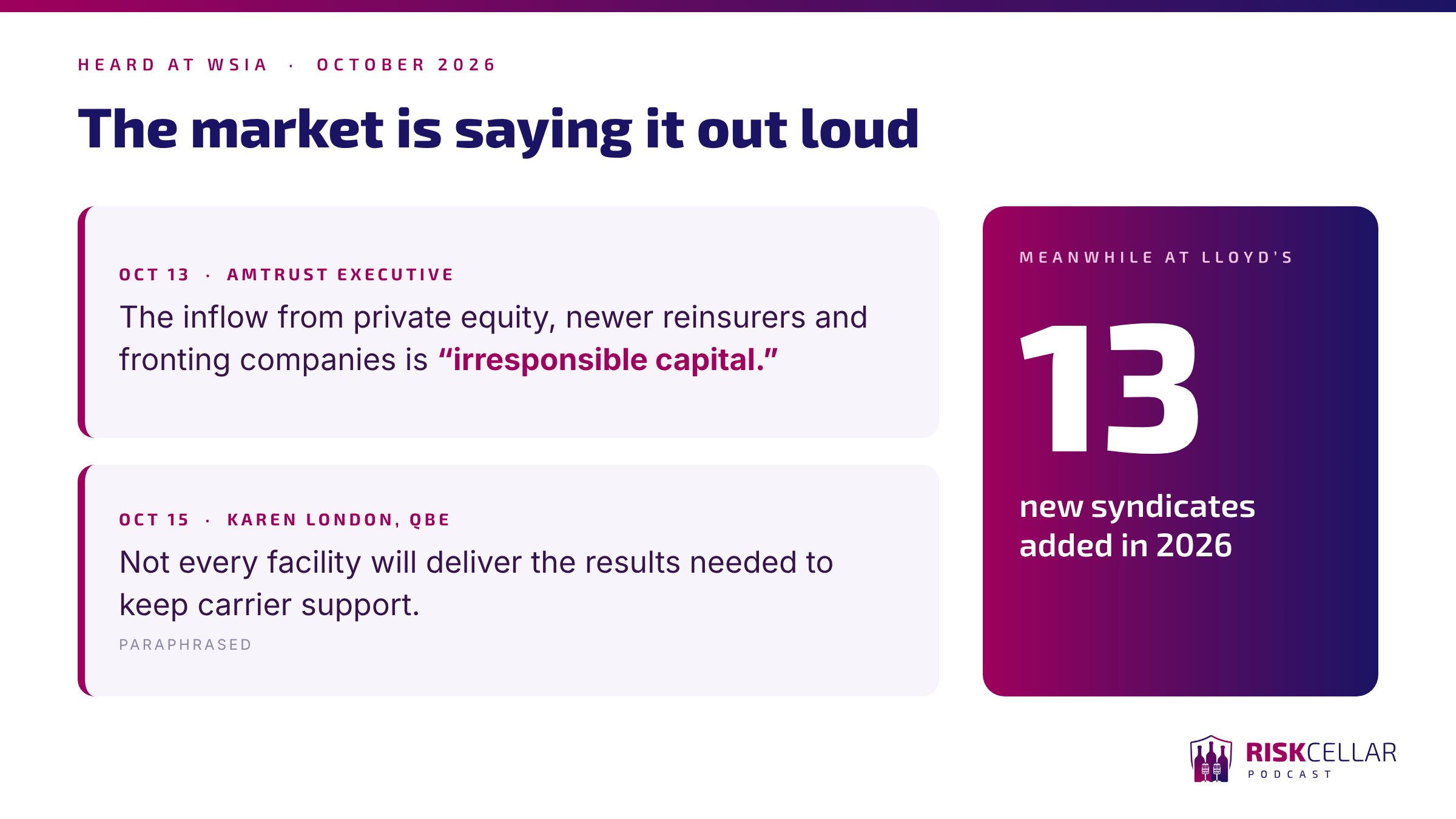
But proximity isn’t the only reason. Casualty is also softening because of a flood of new capital: new MGAs, new markets, new insurtech. Lloyd’s alone added 13 new syndicates in 2026, with a lot of Blackstone money flowing in.
What does new capital mean in a softening market? It means that capital has to be extremely competitive to win business and put premium on the books. That’s a violent cocktail in an environment where losses keep getting bigger. Nuclear verdicts are rising, average verdicts keep climbing, and inflation is making already problematic lines worse.
So why are we talking about this? Because we’ve seen this cycle before. These prices are short-term gifts brought to you by irresponsible capital.
What naive capital is
Naive capital (or irresponsible capital, take your pick) is money that prices to put premium on the books, not to pay claims ten years from now. It’s measured on growth and deployment. It often doesn’t hold the tail, because fronting arrangements and sidecars pass it back. And it’s the first to leave when losses develop.
There was a lot of chatter about it at WSIA. On October 13, an AmTrust executive called the inflow from private equity, newer reinsurers and fronting companies “irresponsible capital” that’s pushing GL rates down in ways the fundamentals don’t support. Two days later, Karen London of QBE (who I know from her Berkshire days) warned that not every facility will deliver the results needed to keep carrier support.
Exhibit A: Corgi
Now let’s tie this together with our favorite punching bag of late, Corgi. I’m not picking on them for sport. I think they fit the naive capital mold, just not the usual version where an MGA comes in and leans on a fronting company. Here we have a company writing mostly on unrated paper, pricing aggressively, and, in my opinion, putting out limits it hasn’t publicly shown it can back. So let’s look at what’s on the record.
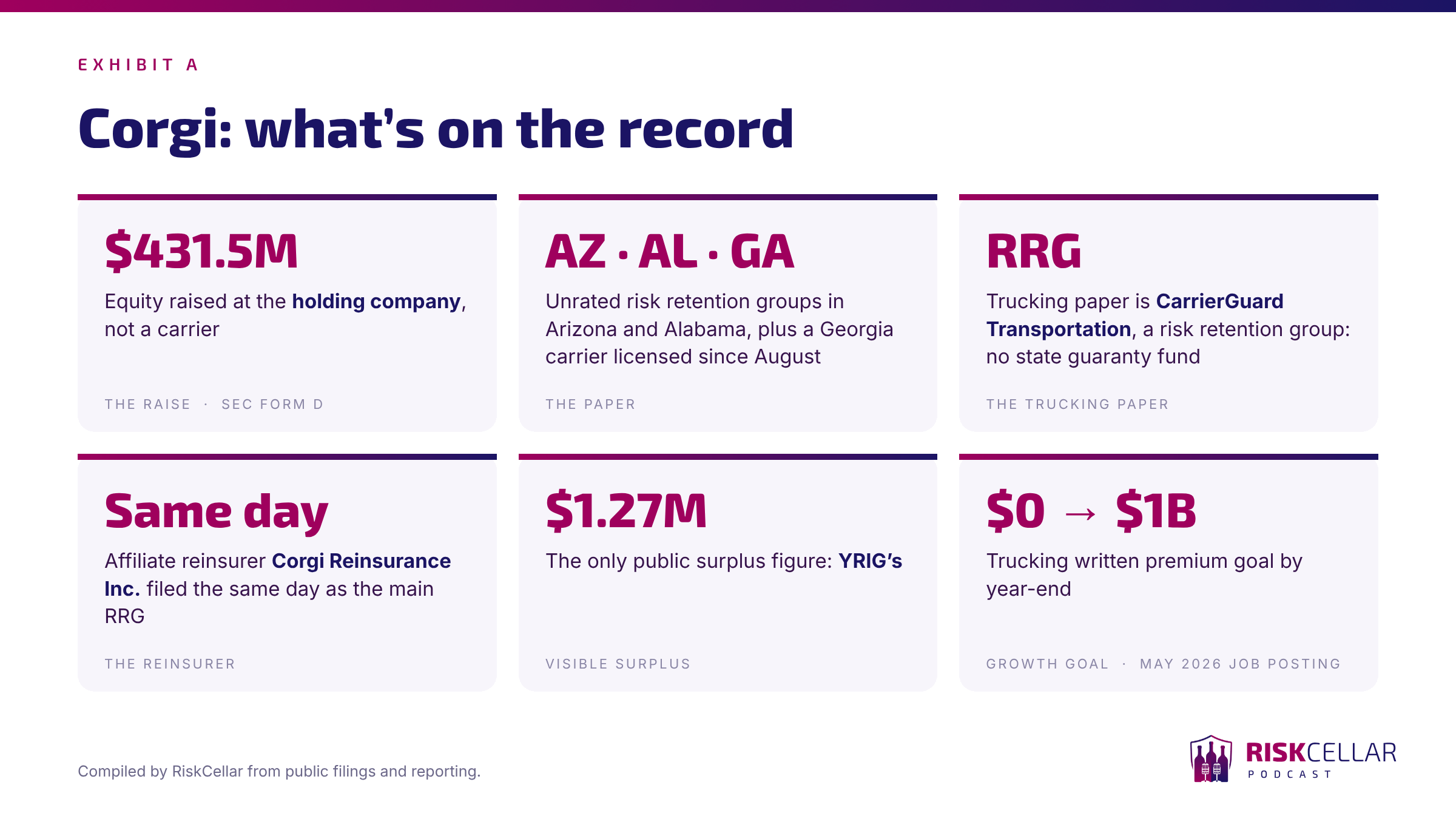
- The raise: $431.5M in equity, raised at the holding company, not a carrier (per its SEC Form D filings).
- The paper: unrated risk retention groups in Arizona and Alabama, plus a Georgia carrier licensed since August.
- The trucking paper: CarrierGuard Transportation, a risk retention group, which means no state guaranty fund behind it.
- The reinsurer: an affiliate, Corgi Reinsurance Inc., filed the same day as the main RRG.
- Visible surplus: the only public figure is YRIG’s, at $1.27M.
- The growth goal: trucking from zero to $1B in written premium by year-end, per a May 2026 Corgi job posting.
So here’s the question. The money clearly exists, but how much of it sits inside the risk-bearing entities versus the holding company? With roughly 375 employees, the cash burn is probably substantial. Here’s how I’m thinking about it. These are my own estimates, not Corgi’s numbers. They’re built from public headcount data and standard cost assumptions, starting from the $431.5M raised.
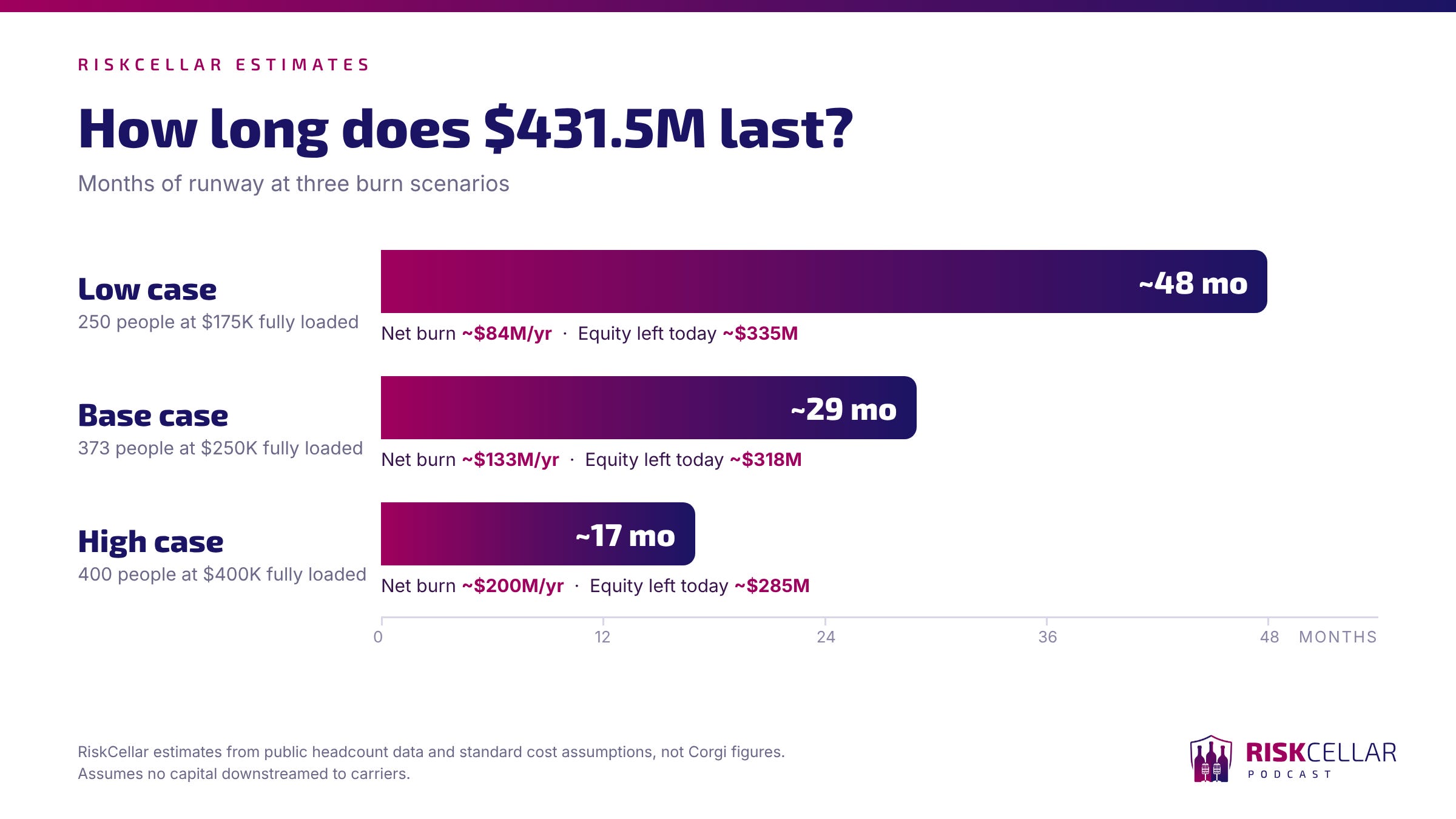
- Low case: 250 people at $175K fully loaded. Net burn of about $84M a year, about $335M of equity left today, and about 4 years of runway if none of it goes into the carriers.
- Base case: 373 people at $250K fully loaded. Net burn of about $133M a year, about $318M left, and about 29 months of runway.
- High case: 400 people at $400K fully loaded. Net burn of about $200M a year, about $285M left, and about 17 months of runway.
Here’s the catch. Every dollar that capitalizes a carrier is a dollar that can’t pay salaries, and once it’s in the carrier, regulators have to sign off before it comes back out. The usual rule of thumb is about $1 of surplus for every $3 of premium, and long-tail lines like trucking should run tighter. Using conservative startup ratios of my own (2-to-1 for liability, 1-to-1 for trucking), here’s what the growth plan would need:
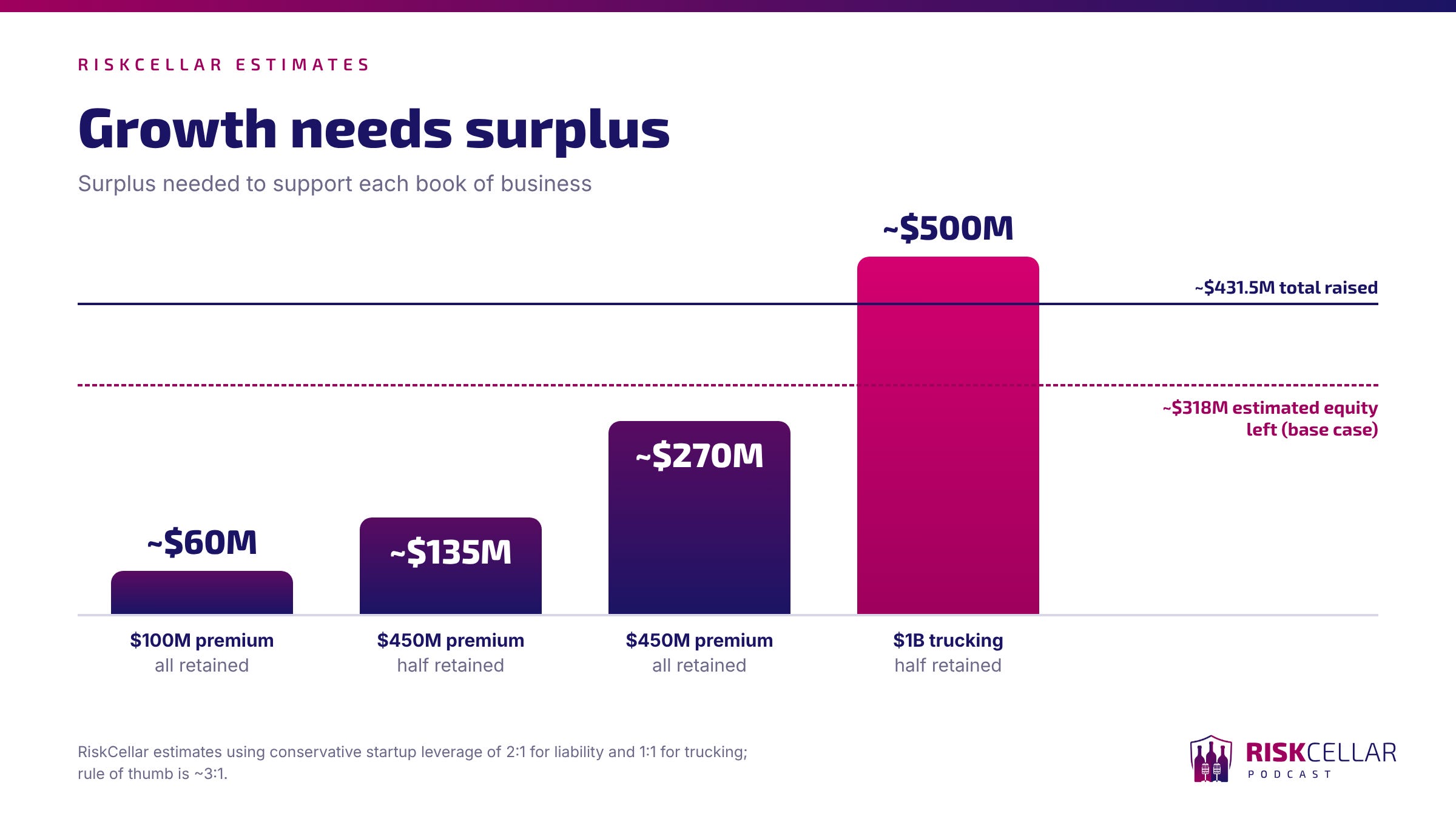
- $100M of premium, all retained: about $60M of surplus, leaving about 23 months of base-case runway.
- $450M, half retained: about $135M of surplus, leaving about 16 months.
- $450M, all retained: about $270M of surplus, leaving about 4 months.
- $1B of trucking, half retained: about $500M of surplus, which is more than all the equity raised.
And if Corgi is ceding risk to its own affiliated reinsurer, does that risk ever actually leave the group? If it doesn’t, that’s a problem.
To be fair to Corgi, here’s their side. An executive said on the record, “The money is on the balance sheet. We have it sitting in the bank.” Regulators licensed these entities, most RRGs are unrated, and they just hired veteran underwriters from Canopius and Chubb. Their trucking limits are also reportedly up to $1M per policy, which caps much of the exposure to any single verdict. Those are real counterpoints to the house-of-cards theory you hear around the market.
Where the naive part comes in
Trying to write $1B of premium in a year in arguably the toughest line there is, trucking, is what naive capital looks like.
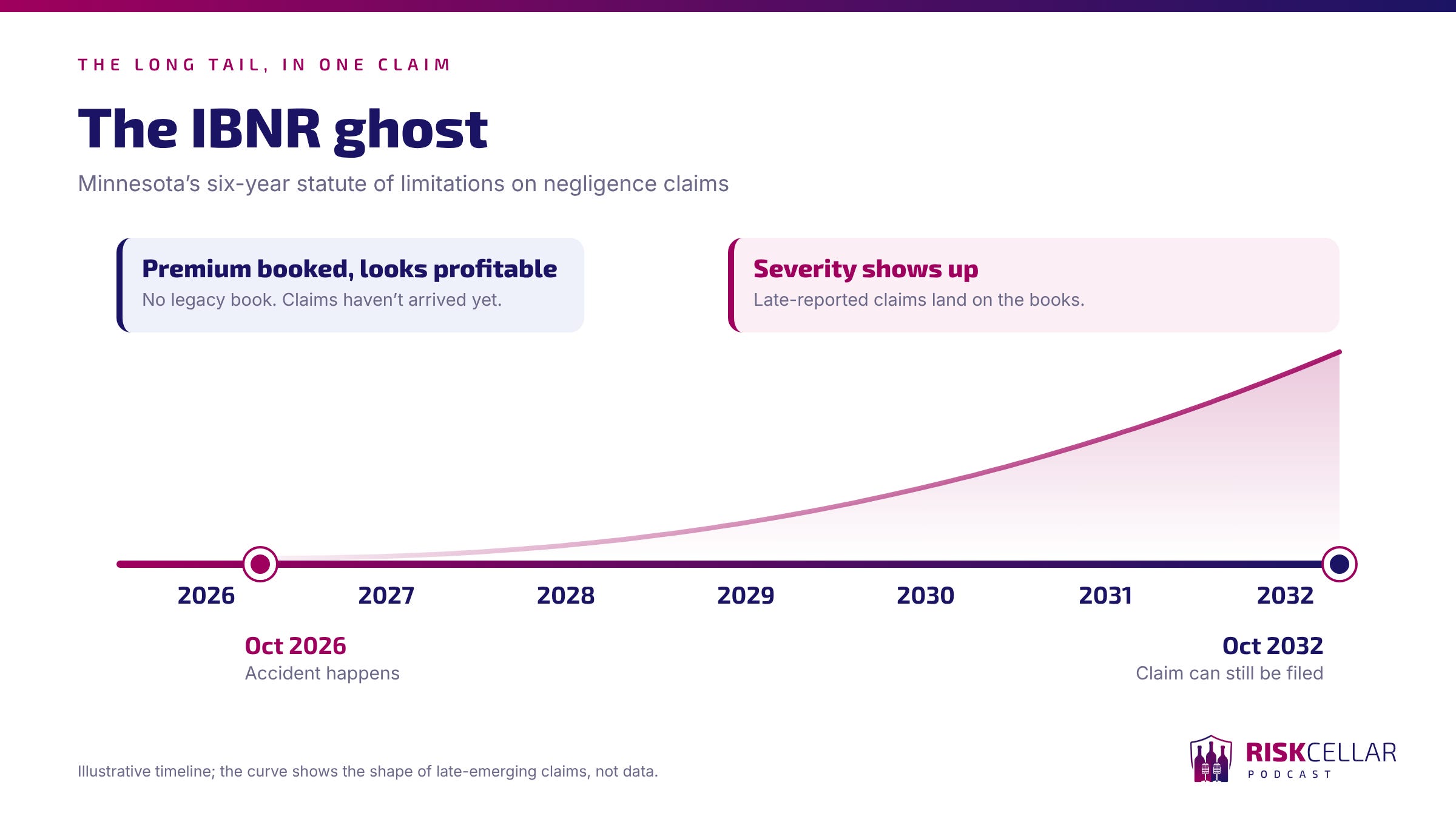
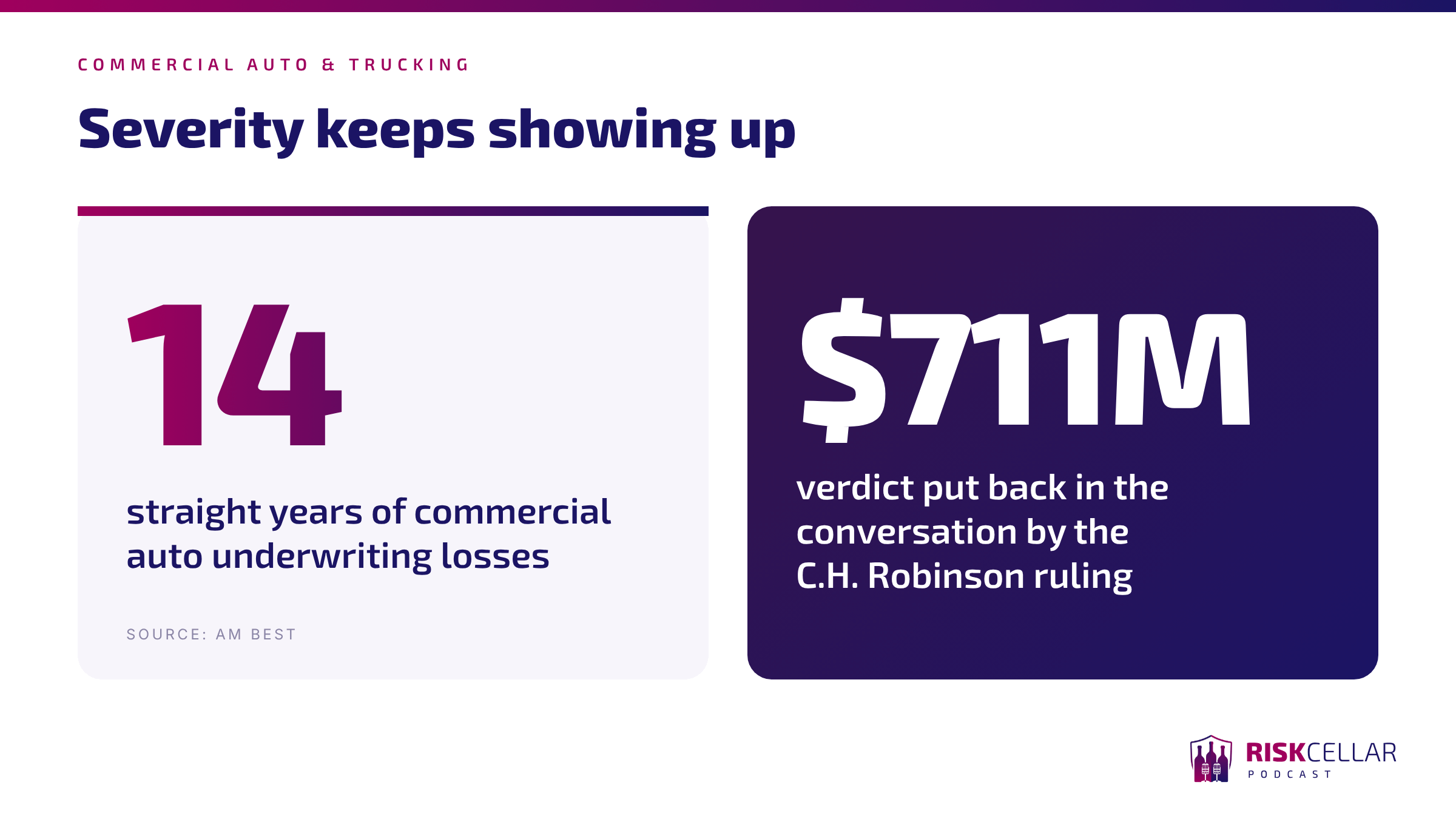
Auto liability and casualty losses take years to show up. New capital can look great early because it has no legacy book and the claims haven’t arrived yet. I live in Minnesota, which has a six-year statute of limitations on negligence claims. An accident that happens today doesn’t have to be filed until 2032. So naive capital can keep putting premium on the books while the IBNR ghost quietly racks up the body count. Then, bam: a few months of severity show up at your door, and that market looks a lot worse. Commercial auto has posted 14 straight years of underwriting losses, and the C.H. Robinson ruling just put a $711M verdict back in the conversation. If a company is sitting on $431M raised, a billion in premium and billions in limits, and little of that risk is laid off outside the group, it doesn’t take many of those to wind it down.
So who’s left holding the bag? In 1996, Lloyd’s had to create Equitas just to quarantine its asbestos-era losses, and a decade later it took Warren Buffett to pick up the pieces. This one is a lot more predictable. And Mr. Buffett has handed Berkshire to Greg Abel and is probably watching YouTube with his grandkids, so I don’t see anyone lining up to pick up this particular trash.
What producers should do Monday
If you place a client with bad capital and it goes under, it’s your E&O on the line. Here’s how to keep it out of the equation:
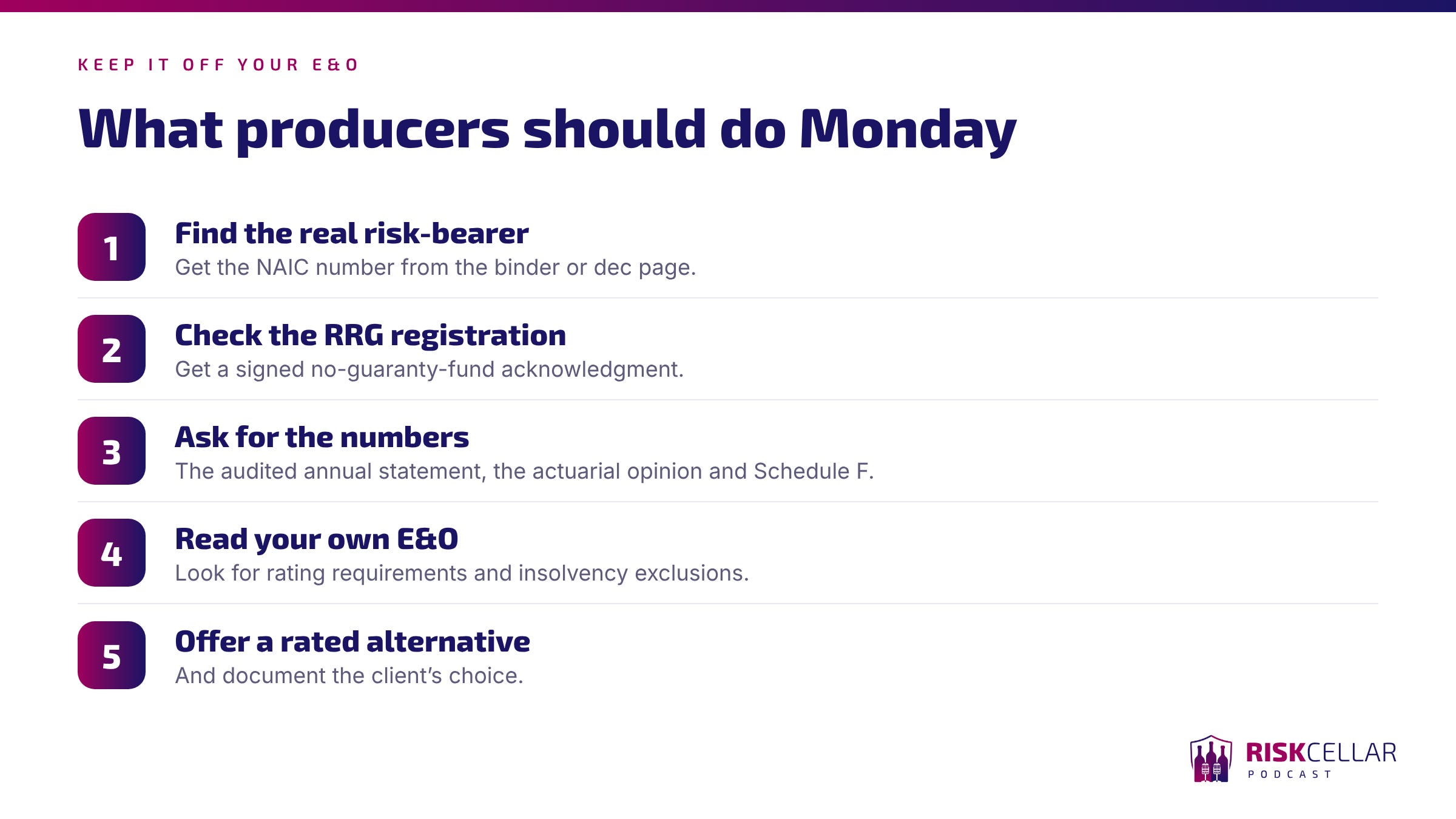
1. Find the real risk-bearer. Get the NAIC number from the binder or dec page, not the name on the website.
2. Check the registration and the notice. Confirm the RRG is registered in your client’s state, and if your client goes with an unrated entity, get their signed acknowledgment, including that there’s no guaranty fund.
3. Ask for the numbers. Request the audited annual statement, the actuarial opinion and Schedule F, which shows the reinsurers and anything ceded to affiliates. I haven’t been able to find Corgi’s.
4. Read your own E&O. Look for rating requirements and insolvency exclusions.
5. Offer a rated alternative, and document the client’s choice in writing.
Price is an easy sell for a producer and an easy buy for a client. Capital is what they find out about at the claim. Cheap capacity is a loan against your reputation, and naive capital calls that loan at the worst possible time. Don’t get your loan called.
Thank you to our sponsors
RiskCellar doesn't happen without the partners who back it, so a sincere thank you to the three companies presenting the show.
Freeflow.ai is building AI agents for P&C carriers that review every claim file instead of the small sample most carriers get to. Thank you for believing in what we're doing and for pushing the industry to do claims better.
Imperial PFS has been financing commercial insurance premium since 1977 and is still family-held. Thank you for being such a steady partner, and for helping agencies keep and serve their clients.
Coverflow uses AI to take the tedious work out of policy checking and AMS updates, so agency teams can spend their time growing. Thank you for backing a show that's all about working smarter.
To all three: your support lets us keep pouring into insurance, risk, and the decisions that protect what people have built. We're grateful to have you at the table.
And to everyone reading and listening, thank you for being part of it.
Brandon & Nick
The NAIC number check is the step most agencies skip. In quote comparison I add the risk-bearer, rating and guaranty fund status as columns next to premium, so the cheapest quote never looks comparable by default.