


Muses have taken many forms over the years. In modern history, drugs have been credited with some magical creativity and (a)muse-ment. Tom Petty, after writing Mary Jane's Last Dance, gave it the name of the "Musical Drug". Unfortunately for human creativity, we've now anointed an agentic, probabilistic algorithm as the new muse, and then proceeded to make it look like a Pokémon pocket charm. What are we doing here?
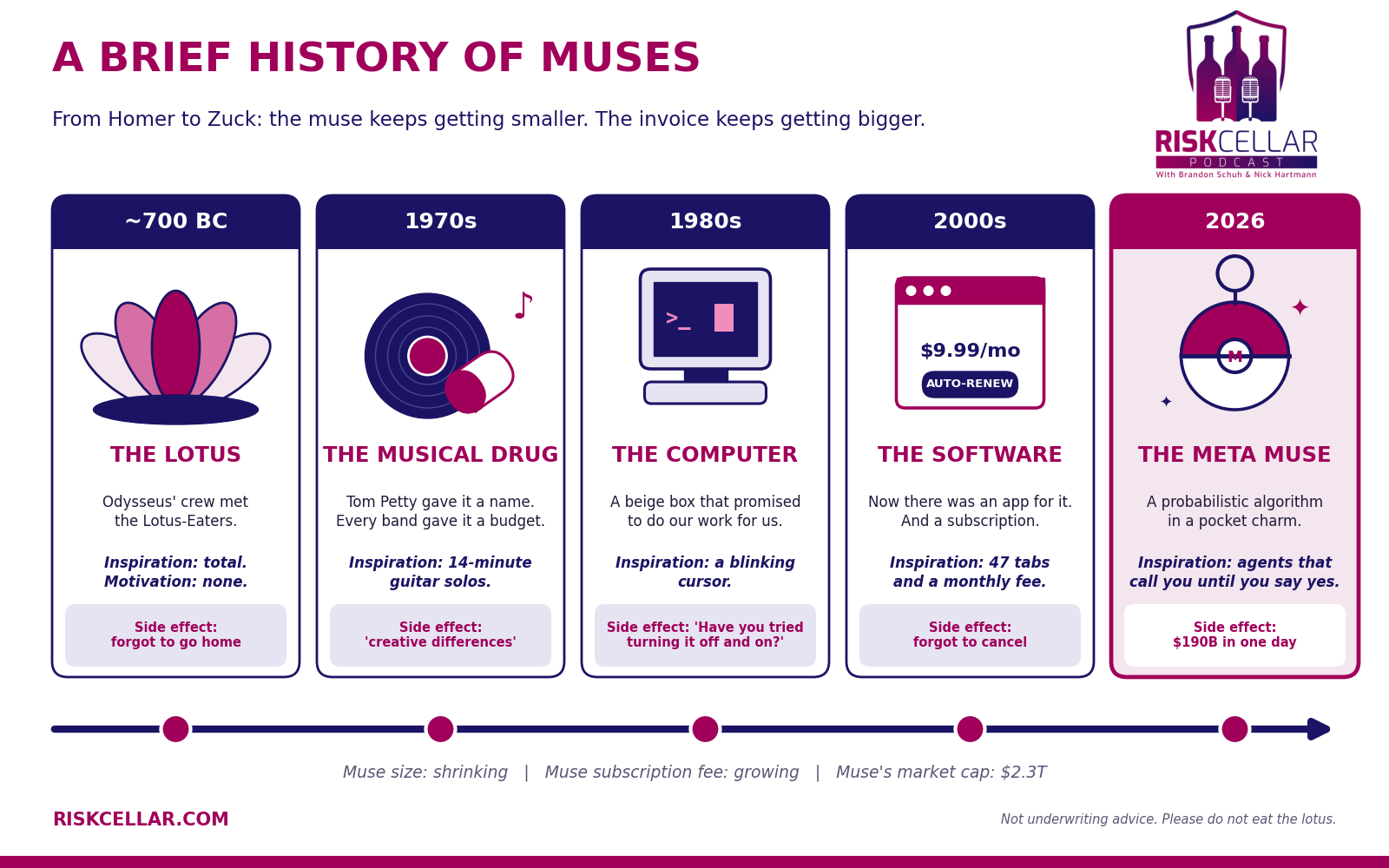
This week, Meta put Mark Zuckerberg on stage for an apocalyptic-sounding presentation, mimicking Steve Jobs' style of performance with black tee shirts and gold chains (Steve Jobs is probably rolling over in his grave), to show us the future of tasks. Let me start this conversation by saying that Muse looks to be an incredibly high-functioning tool, and another idea theft by Zuck, with a likely more efficient way to monetize a tool that was already invented by others. The list of direct precursors of early action agents is long: OpenClaw, Instinct, Hermes Agent, Devin AI, and the list goes on.
Muse has gotten such enormous coverage and stock market support because Meta has such an enormous platform to launch it from. Meta already has WhatsApp, Instagram, Threads and Facebook, with billions of users to both advertise to and act as an arbitrage, while also providing simple APIs (connective tissue) between those integrated applications. That's a huge head start on any other platform on the market.
Zuck has always been incredibly gifted at monetizing his product. He's also incredibly gifted at diluting the great parts about humanity. He's a tech nihilist with one thing he cares about: shareholder value. And he's damn good at that. Meanwhile, the universal populace continues to suffer the consequences of his last round of shareholder successes. The courts agree, assessing Meta the largest penalty ever through the latest settlement, which came about after four state attorneys general sued Meta in Oakland, resulting in $18b for the families of victims who have had to endure the wrath of a Meta social media product for lying, cheating and destroying the mental health of millions of children around the world. But I digress. Let's talk about Muse vs. insurance.
The market's response
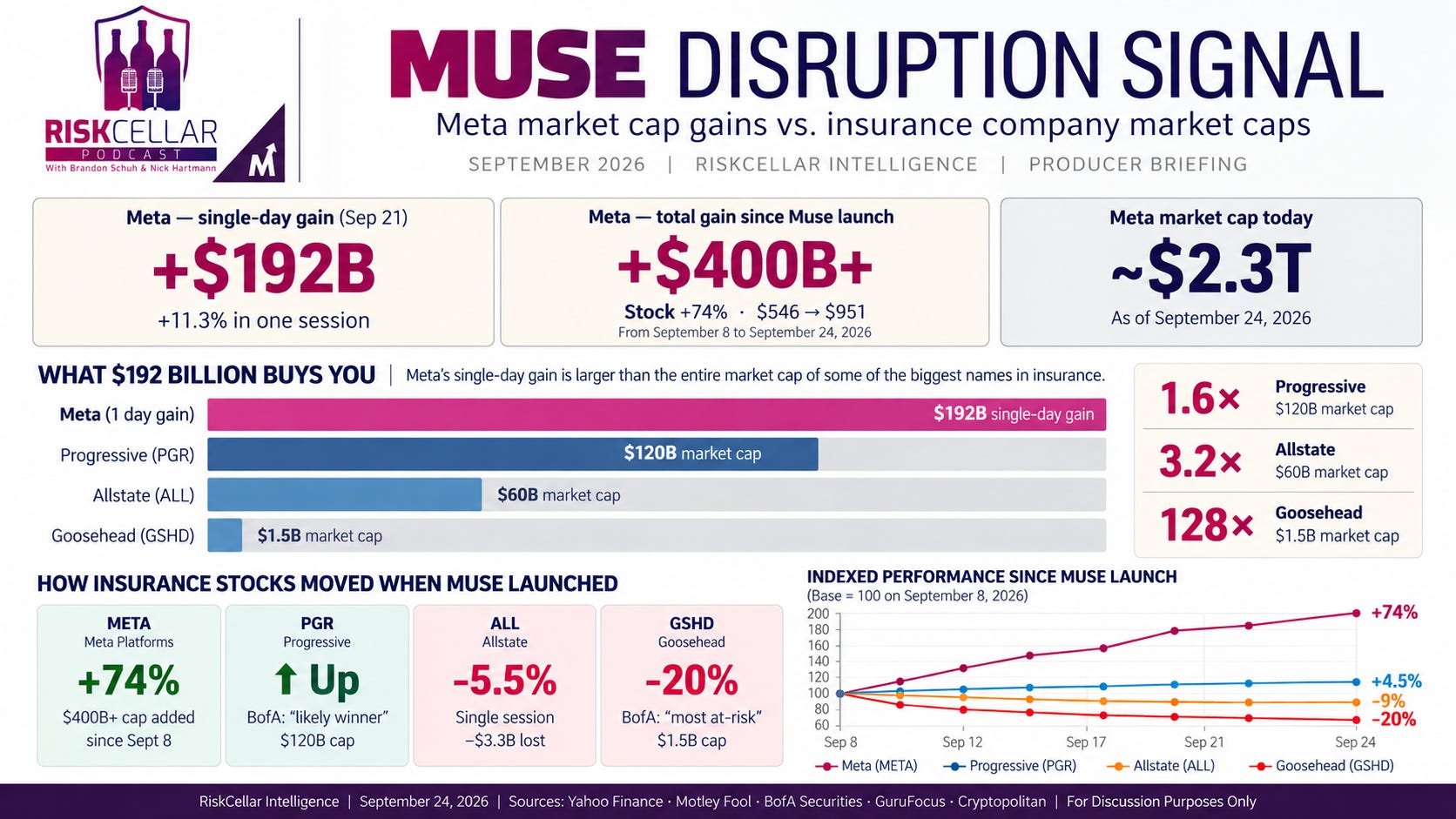
On the day of the Muse announcement, Meta's market cap (their total market value traded on the open stock market) increased by $190B, roughly 10% of their total value. Their weeklong gain was $400B. Their total market cap went from $1.9T to $2.3T.
Now, why does this have anything to do with insurance? On Wednesday of last week, Goldman Sachs' trading desk published their "Consumer Inertia" basket of stocks. In this memo, they argued that because these action-oriented agents can be prompted to compare pricing, manage subscriptions, navigate red tape and long phone-call waiting times, and negotiate bills on the user's behalf, they will completely destroy businesses that profit from low customer engagement, complex switching processes and forgetful auto-renewals. That basket of stocks lost 10% of its value within a week of the Muse debut.
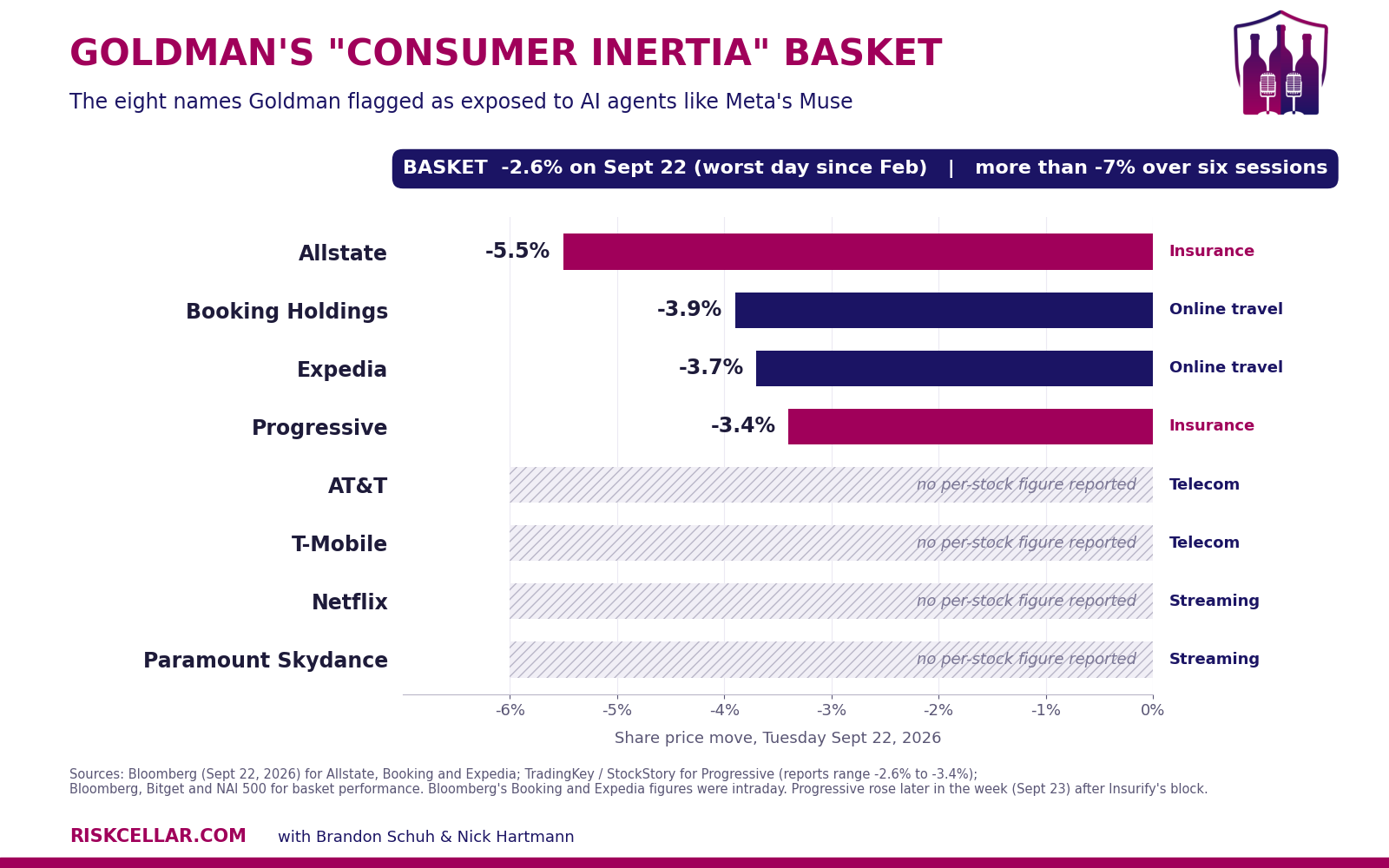
Insurance was in this mix, specifically home and auto personal lines. It was not the only industry. We also had travel aggregators, subscription, membership, software, telecommunications, utilities, retail financial services and wealth management. The two major insurance companies on the list from Goldman were Allstate and Progressive. Interestingly, Allstate had the big drop of around 5.5%, but Progressive actually went up. The later explanation was that Progressive has a more technical infrastructure that might allow them to adapt better and win over AI agents that are shopping.
Later in the week, a lot of major platforms across sectors started announcing bans of Muse agents. One you probably heard about was Amazon. Amazon already has an agentic AI integrated into its system that can assist shoppers, but it obviously requires the shopper to be present for the shopping. An insurance-specific example was Insurify, which has banned Muse bots from entering their platform. The workaround might be that Muse can also call and bother the hell out of anyone until they get an answer. Reports from the last week describe profound annoyance. Many companies and phone bank companies have noted many, many calls that have ended, dropped or stopped short because of Muse agents that won't take "no" for an answer.
Now, back to the numbers. $190B in one week. That number (refer to my chart herein) is bigger than the total market cap of Progressive, Allstate and, for fun, I added Goosehead, an agency franchisor, which took the biggest hit. That combined market cap is $180B. It's a demonstrative illustration of why the market thinks this is important. I happen to think the market overreacted, and we can get into that next. But it's not a nothing week, and it's not unimportant to the insurance space. You should be examining this and continuing to think about why you, whether an agent, broker or insurance company, are different and more useful than an AI.
My analysis
Okay, my overall analysis of action agents like Muse: they are likely to take a chunk out of transactional relationships. And I think the dilution of Allstate's value in the public markets is likely an accurate trend that we'll see continue. Whether action agents continue to ban cross-platform activity likely doesn't matter, because the proliferation of these technologies will continue. It may end up akin to the streaming wars, where everyone has their own agent within their platform. Which would be a real pain in the ass, but get ready for it.
So the trend continues in our market: transactions with less relationship value will keep being removed from daily life. That's no surprise. The question for bigger brokers and more complex transactions is whether customers will start using these agents for smaller, more administrative tasks. I, unfortunately, think the answer is yes.
More sophisticated, tech-style clients are already using LLMs (Claude, ChatGPT, Copilot) to answer or "polish" emails. That's fine, but it sometimes creates a frustrating response on the service side of the business, because of the perceived "fact-based" trust clients place in LLMs. The truth about AI knowledge is that most models don't actually have the nuanced insurance data (and won't), so their ability to produce an answer that closely mimics an agent's institutional knowledge is low.
But the bigger problem with a switch to action agents for small administrative communications and information gathering is the severing of the actual relationship with your service person, regardless of industry. Much of the rapport built with your broker or agent happens in the small tasks. Not the pitchbook-style meetings or renewals, but the daily tasks and questions. I would encourage those on the broker side to attempt (and this might be tough) to thwart these circumventions and follow up with a physical phone call to maintain the relationship that way, or just pick up the phone more and talk to people outside of the back-and-forth fact gathering. Zuckerberg may be a master of monetizing the digital destruction of our lives, but that doesn't mean we have to let him. It's clear that Gen Z and younger generations are already pushing back way more than we millennials ever did. Props, kids! This is likely to show up in the actual numbers eventually, after all this capex (compute) spending comes out in the wash.
The bubble question
Before Goldman talked about the death of consumer inertia, they also poured cold water on Meta's a(muse)ing release. They highlighted that the hyperscalers (Meta, MSFT, Google/Alphabet) are on track for $800b in capex spending this year and $1.1T next year on AI chips (NVIDIA). They warned these firms will need consistent AI services revenue of $300B annually just to break even. FYI, we're nowhere near that number.
I know you probably hear it every day from some AI (less than) enthusiast, but this is 100% a bubble. Until there are efficiencies being made by the consumer companies, those that actually earn directly from the consumer, AI is a nice-to-have but not a must-have. There will be a correction in this market, and some of this fun is going to fizzle.
Thanks to our sponsors -
Freeflow.ai: AI agents built for P&C carriers. Most carriers audit less than 5% of claims, while Freeflow's agents audit 100% of files continuously, grounded in each carrier's own best practices.
Imperial PFS (IPFS): A leader in commercial insurance premium financing since 1977, and still privately, family-held. With 30+ branches and 600+ associates across North America, IPFS financed roughly $17 billion in premium across 850,000 loans in 2025.
Coverflow: An AI-powered platform that handles everything from policy checking to AMS updates. It spots differences between policies, flags new exclusions, endorsements and limit changes, and helps protect against E&O.
Interested in sponsoring? Check out our media kit.